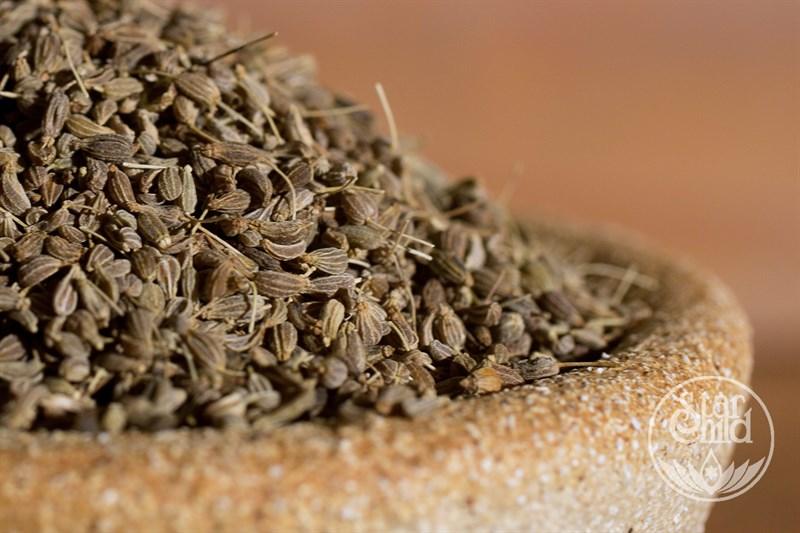
ANISEED- ORGANIC
Pimpinella anisum
History and Folklore
Native to the eastern Mediterranean region, Asia Minor, Greece and Egypt, this dainty member of the carrot family has been used as food and medicine for thousands of years and finds an honourable mention in the famous Ebers Papyrus, which dates back to 1500 BC. Aniseed has a pleasant, sweet, aromatic flavour that is often used to disguise other, less appealing ingredients, especially in compound medicines. Today it has lost much of its medicinal reputation, though it is still an important flavouring agent and particularly in demand for the manufacture of certain alcoholic beverages such as Raki, Ouzo, Pernod and the like.
In Rome it was traditionally baked into special wedding cakes, probably to add a little stimulating sweetness to the wedding night. Aniseed became very popular in Britain, but was rarely grown here because the climate was not conducive to bringing the plants to fruition. Thus, most aniseed was imported and apparently in quite large quantities, a situation which King Edward I knew to exploit for his own purposes: being short of funds he simply levied an import tax on aniseed to raise money to pay for repairs to London Bridge.
Aniseed's sweet aroma not only appeals to humans - animals are also highly attracted by it. Aniseed is to dogs as catnip to cats - the fake rabbit used in Greyhound races is stuffed or scented with aniseed - and rats, mice and fish are also attracted by its scent. Rumour has it that it wasn't so much the pipes of the Pied Piper that lured the rats of Hamlin, but rather the content of his pockets, which were stuffed with Aniseed. Aniseed is also sometimes used as fish bait.
Medicinal Uses:
In the past it was much valued as a smooth muscle relaxant, especially for nervous indigestion, cramps and flatulence, but also, when cooked in milk, as an excellent agent to soothe coughing fits and tight chests. It is mildly galactagogue and old herbals often mention its aphrodisiac properties
Magical Uses:
Used in love magic to open the heart chakra and clear emotional blockages that may prevent one from finding love. Worn as a magical amulet it may help finding contentment and happiness. Aniseed is used to stuff dream pillows to ward off nightmares and induce a restful, happy sleep. It safeguards the soul on spirit journeys and astral travel and offers protection against nightmares. It may be used to open the inner eye to prepare for divination rituals and psychic channelling. Use it as a special offering if your spirit or totem animals are dogs, or to invoke Anubis.
BOTANICALS:
Plants nourish and feed us, add spice to our life, bestow health and beauty, scent and colour and brighten our days. They mediate love, hope and gratitude; they clothe and cleanse us, they heal and soothe our bodies, minds and souls. They touch every aspect of our existence, from our daily sustenance to the air we breathe, to the keys to other dimensions. They are the alchemists that turn sunlight into the green force of life, continuously revolving, restoring, rebirthing through the cycles of time. They truly are the greatest gift of nature, yet also the one we most take for granted.
Star Child's range of botanicals derives from many regions and traditions of the world. We supply only the best quality herbs, using organically grown and sustainably harvested sources if available. The greater the demand for organic products the more readily they will become available. Your choice to buy and our commitment to supply organic herbs is part of the driving force that sows the seeds for a greener, healthier future.
USE:
There are dozens of ways in which herbs can be used. Many culinary herbs not only impart a great flavour but also have subtle effect on the digestive process. Other herbs are more medicinal than culinary and can be used as remedies, based on the wisdom of age old traditional plant knowledge. For more detailed information on the different types of preparations that can be made with herbs, please refer to the BOTANICALS USAGE section.
CAUTION
We support the notion of taking responsibility for one's own well being and thus strive to make all herbs available for use at your own discretion. It should be noted however, that not all herbs are safe to use in all circumstances. Special cautions may apply when suffering from certain medical conditions, when taking synthetic prescription drugs and during pregnancy. Research and familiarize yourself with any herb you intend to use and make sure you are aware of all special cautions that may apply. The information given here is based on thousands of years of traditional use. It is intended for educational purposes only and is not intended to replace a visit to a medical professional where this is necessary.
If symptoms persist or re-occur, or if you are suffering from a serious medical condition, or if you are presently taking prescription drugs, we recommend that you consult a qualified doctor or practitioner before attempting to help yourself. Look for a practitioner/doctor who you can trust and who is prepared to explore natural health alternatives with you.
Pregnancy is a very special time. If chosen wisely herbs can give tremendous support throughout the entire process. However, due to the vulnerability and sensitivity of the unborn child it is especially important to make sure that the herbs you are using are safe. (This also applies during the time of breast-feeding as all substances ingested by the mother are processed and passed on with the mother's milk). Many herbs may be useful during the latter stages of pregnancy or during labour, but could be dangerous during the first few months. Inform yourself - don't risk regret.
<< Back to products